Solo at Rothschild
a space for solo exhibitions, created by the Edmond de Rothschild Center especially for members of the Edmond de Rothschild Center network. Its purpose is to foster the development of new projects and facilitate the production of existing works by providing curatorial guidance and encouraging group thinking processes.
Three solo exhibitions at the Edmond de Rothschild Center, floor -1.
May-December 2026
Participants: Alma Ben David and Lior Harel, Amir Cohen, Oren Rozensal
Curators: Tali Romem, Gabi Glick, Einat Gabai Levi
[3/3]
Mind the Fae | Oren Rozensal
Curator: Einat Gabai Levi
No pit is here wherein to fall:
Aye—at the fount you well may stare,
But nought save pebbles smooth is there,
And small straws twirling one and all.
Hie thee home, and be thy pray’r,
Save us all from Fairy thrall.[1]
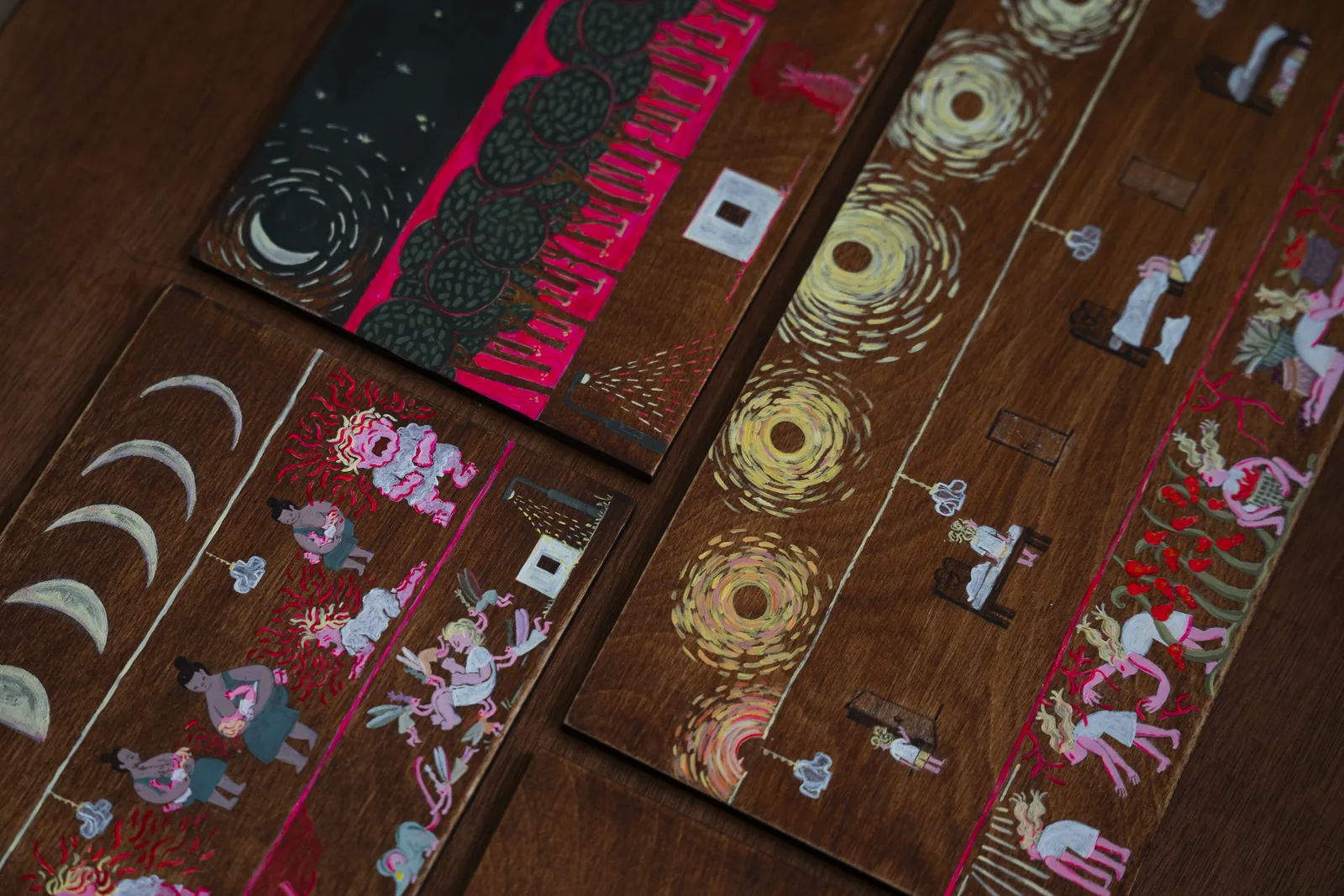
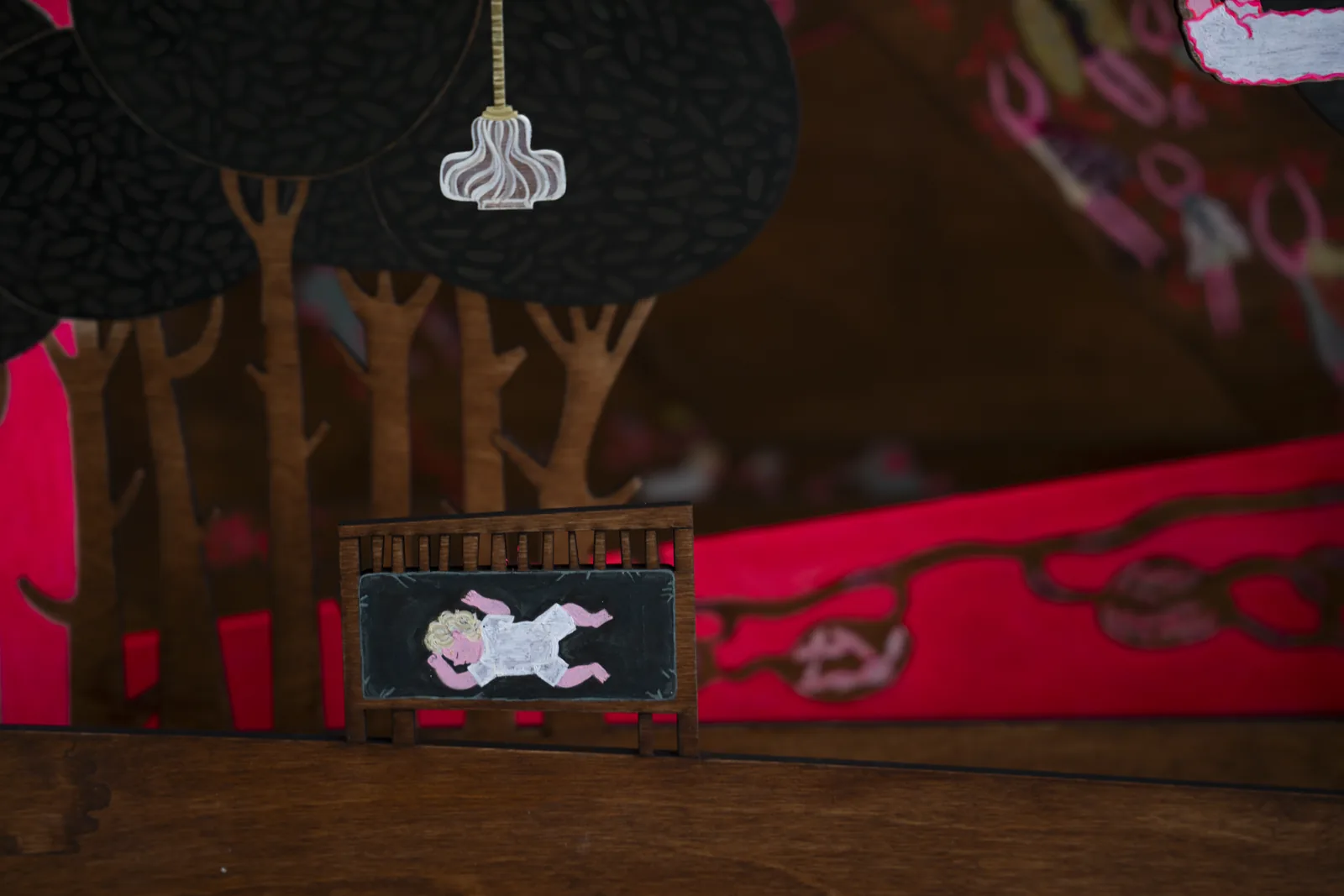
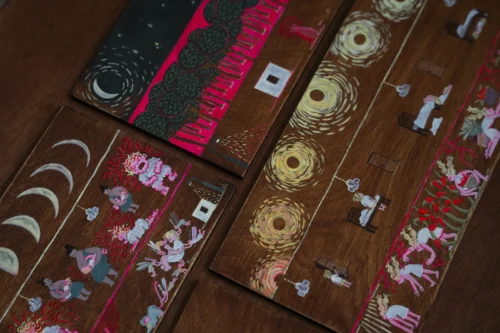
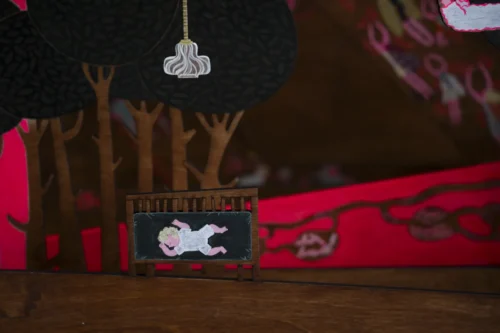
A single frame with a baby cradle in the room. The cradle holds two babies: one is sleeping, the other is missing. A room that holds a secret, clinging to the most naïve and severe possibility. Two extensions of a simultaneous reading coexist, until one forgets which is the source and which the echo. One look at the streetlamp rouses the dreamer from a nightmare and awakens the fairy forest – and they are the same world, and the street is the same, and the window looks out to both room and forest.
Out of the missing space in the cradle, Oren Rozensal reconstructs the changeling myth familiar from Irish folklore and extracts it as the starting point for fantastic transformations. It is told that fairies, members of the “Good People” who covet human children, are in the habit of visiting homes at nights and swapping infants. In their stead, they leave a mark in mundane space: a fictitious doppelganger or an enchanted echo. Legend tells of mothers who used to search for hidden signs and try to restore the biological order. That is the moment when the gaze is ruptured and the familiar becomes uncanny.
This exhibition is inspired by the research and literary work of Irish poet and author William B. Yeats. In the late 19th century, as part of the Celtic Revival, Yeats ventured out to the west-Irish countryside to document popular folklore. In his constitutive anthologies, he formulated a unique anthropological perspective and redeemed the fairies dark nature. His studies emphasize that the fairies are ambivalent entities representing a vibrant, vivacious and volatile force that constantly interacts with the human psyche, feeding on its desires and deficiencies. Per the poet, twilight is the time when the crust of reality is thin enough to enable them to invade the space inhabited by mortals.
Rozensal leverages the visual potential of this twilit space. She deploys a setting where the single frame is duplicated to become a silent animation, flickering between two and three dimensions. The severe contents take shape in the medium of narrative painting, inspired by children’s books and folklore art. The craftwork is etched on domestic objects charged with the past tense: an old louver window and wooden table legs echo a foreign material language. These encounter a montage screening of “orphan” archival films, which sentence the observer to be the owner of that lost child.
In a mythical room replete with ornamentations of varying scales, the house becomes a forest and flies become fae. Reality adopts several scenarios simultaneously. The prologue is the epilogue; the narrative unravels and the perception of time comes undone. No distinctions remain valid in space, just as there are no good or bad fae. They are a combination of obscurity and beauty that sizzle under our feet. They forever envy the finality of our being. All we have left is to be touched by their longing.
In the past, belief in fairies was not a matter of ignorance or empty illusion. It served as a profound social-psychological mechanism, a desperate existential metaphor, design to name the darkest circumstances of being. The exhibition proposes to convert the doubt that lives beside us into a second narrative, a double derived from the possibility of parallel embodiment. Born out of our secret fears, this creature can elicit compassion out of our abject mirror image. In this dual space, the source is not superior to the duplicate, which is nothing but a second consciousness, admonishing: “Mind the fae”.
[1] Samuel Ferguson, “The Fairy Well of Lagnanay”. Project Gutenberg.